The scott curl machine is a dedicated bicep training fitness device featuring a fixed inclined preacher pad to lock the upper arms in a stationary forward position, separating bicep exertion from other upper-body muscle groups, with customizable seat heights and thick comfortable padding that stabilizes your posture throughout the curling motion to maximize muscle stretch and contraction at every movement phase.
The Scott Curl, widely recognized as one of the most precise isolation exercises for bicep development, stands out from conventional arm workouts for its fixed mechanical trajectory and targeted muscle activation. Utilizing a specialized inclined preacher bench, this exercise eliminates body swinging and inertial cheating, locking the upper arms in a stable forward position to impose continuous tension on the biceps brachii and brachialis. Ideal for fitness enthusiasts aiming to fix uneven arm development, enhance peak bicep definition, and break training plateaus, the Scott Curl delivers controlled muscle stretching and contraction that standard barbell or dumbbell curls cannot replicate, making it a staple in professional arm training routines.
Core Muscular Benefits of Scott Curl Training
Standard Movement Form and Technical Essentials
Optimal Training Application and Adaptation Strategies
Core Muscular Benefits of Scott Curl Training
The primary advantage of the Scott Curl lies in its unparalleled muscle isolation effect. By fixing the upper arms firmly on the inclined bench pad, the exercise completely restricts the involvement of shoulder and trunk auxiliary muscles, ensuring almost all force output concentrates on the biceps. Different from regular curls that allow body leverage, its constrained movement path targets the short head of the biceps precisely while fully stretching muscle fibers at the lowest movement point, effectively improving muscle flexibility and shaping a fuller bicep contour. Additionally, this exercise reduces unnecessary shear stress on shoulder joints. With the upper arm stabilized in a forward flexed position, the shoulder girdle remains neutral throughout the movement, lowering the risk of overstrain and making it suitable for trainees with mild shoulder discomfort. Long-term consistent training enhances muscle mind connection, enabling lifters to accurately perceive bicep contraction and maximize muscle fiber activation.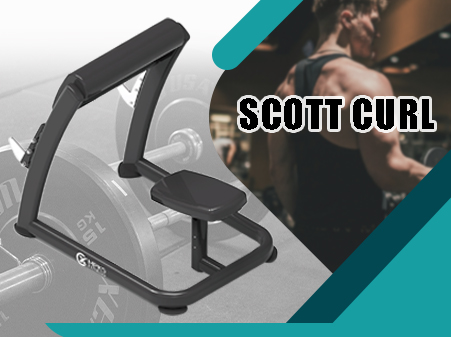
Standard Movement Form and Technical Essentials
Mastering standardized form is the foundation of maximizing Scott Curl training effects and avoiding injuries. First, adjust the preacher bench to a 45-degree inclined angle, sit firmly on the seat, and press the upper arms tightly against the bench pad to keep the armpits close to the edge of the pad with the torso upright and stable. Grip a dumbbell, barbell or EZ bar with a supinated grip, let the forearms hang naturally vertically, and keep the elbows slightly bent to avoid full joint locking at the starting position. During the movement, exhale slowly and curl the weight upward solely by bicep force, pause briefly at the peak contraction point to squeeze the biceps tightly for 1 to 2 seconds to strengthen muscle peak stimulation. Then inhale steadily and lower the weight in a controlled speed, fully stretching the biceps at the bottom position without relaxing muscle tension. The entire movement must avoid swinging the weight or lifting the upper arms off the pad, as such cheating behaviors will weaken isolation effects and cause joint pressure imbalance.
Optimal Training Application and Adaptation Strategies
The Scott Curl is a versatile intermediate-level exercise adaptable to diverse training goals and trainee levels. For beginners, it serves as an excellent foundational movement to standardize bicep force habits and eliminate wrong training inertia formed by casual curling movements. For advanced fitness practitioners, it acts as a refinement exercise for post-bulk shaping, effectively modifying flat bicep peaks and asymmetric muscle development. In terms of training schemes, the classic 8 to 12 repetitions per set with 3 to 4 sets is suitable for muscle hypertrophy, while 12 to 15 high-repetition sets with light weights help carve muscle definition and reduce fat accumulation on the arms. Meanwhile, trainees can adjust training difficulty by switching equipment: EZ bars reduce wrist pressure for comfortable long-term training, while single-arm dumbbell Scott Curls can correct left-right muscle strength imbalance. It is recommended to arrange this exercise in the middle or late stage of arm training to target fatigued biceps for precise stimulation and achieve better training superposition effects.

